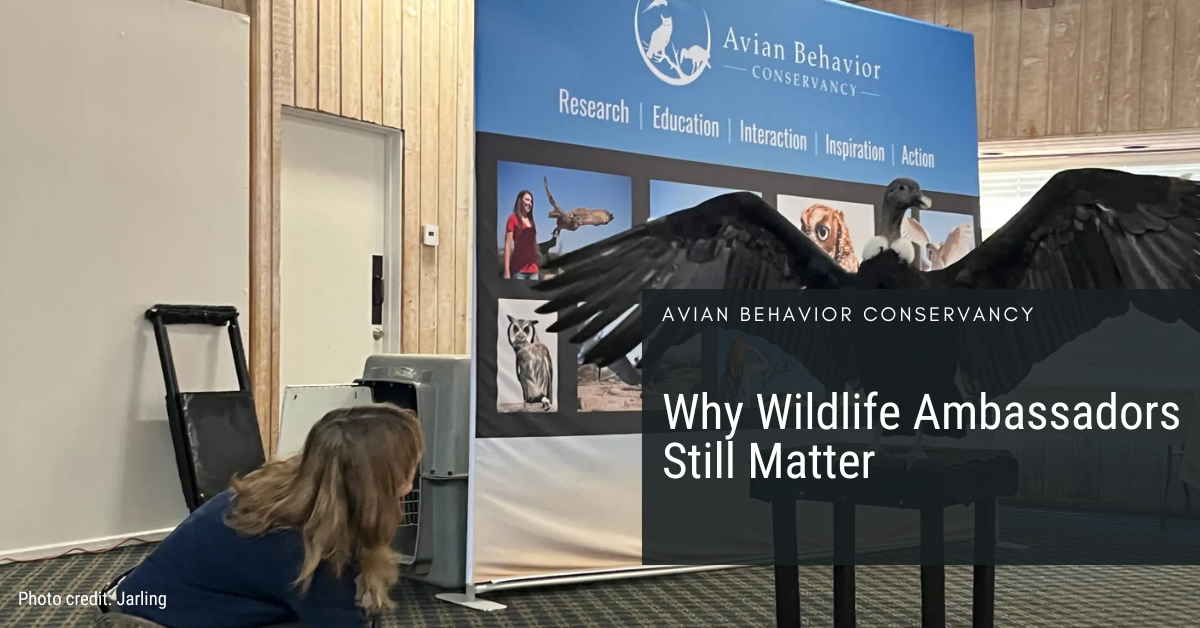
11 Mar Why Wildlife Ambassadors Still Matter
Most people will never see a condor soaring over the Andes. Many will never stand on the cliffs of Big Sur and watch a California condor riding the ocean winds. Some will never even see the owl that quietly hunts over their neighborhood each night. For many audiences, wildlife exists only in photographs, documentaries, or distant places they may never visit. Wildlife ambassadors bridge that gap, bringing the living presence of these animals into reach and creating moments of connection that can spark curiosity about the natural world.
Wildlife education is changing.
As our field becomes more professionalized, we’re asking harder questions about animal welfare, conservation impact, and the role of wildlife ambassadors in public education. Research on animal encounters and conservation behavior is nuanced. Some studies suggest interactions can increase interest in conservation or short-term pro-environmental behaviors, while others find the connection between a single encounter and long-term conservation action is less straightforward.
But one thing is clear: people rarely develop a connection to wildlife through just one experience.
Connection to nature usually grows from many contact points over time—a nature center visit, a school program, a hike, a documentary, or a chance encounter with an animal that sparks curiosity.
Wildlife ambassadors are one of those contact points.
Bringing Wildlife Into Reach
For many people, wildlife exists as an idea rather than a lived experience.
Even animals that live close to us often remain unseen.
Wildlife ambassadors allow our audiences in on a secret world they never knew existed: Did you know that vultures and ravens drool? Or that parrots are usually left-footed? Have actually seen an owl turn their head around 180 degrees, or a hawk look like they are mean-mugging you, only to find out that that heavy brow is a highly specialized adaptation?
Seeing an animal in person—even briefly—turns wildlife from an abstraction into something real.
Conservation Happens Through Repeated Encounters
There is no single experience that creates a conservationist.
People build their relationship with the natural world through many small moments: a program at a nature center, time spent outdoors, books, documentaries, or a teacher who sparks curiosity about animals.
Wildlife ambassadors are often one of the earliest of these experiences.
They provide a tangible starting point—an opportunity for someone to see, hear, and observe an animal up close and begin asking questions about the world it comes from.
Behind the Scenes: Specialized Training
Successful ambassador programs don’t happen by accident.
Training wildlife ambassadors is highly specialized work that takes months—and often years—of careful preparation. Animals are trained using choice-based methods so they can voluntarily participate in programs while maintaining behaviors that are natural for their species.
Ambassadors must learn to calmly move between environments, travel safely, and remain comfortable around new sounds, people, and settings.
The goal isn’t to make animals perform.
It’s to create a partnership where animals can safely participate in educational experiences while maintaining their wellbeing.
Educators Bridge the Knowledge Gap
Ambassador programs are not just about the animals—they are about the educators who interpret them.
Wildlife educators must communicate complex ecological ideas to audiences with very different backgrounds and levels of scientific knowledge. In a single program they may speak with young children, university students, and adults who have rarely spent time outdoors.
Great educators translate science into experiences people can understand and remember—helping audiences notice details they might otherwise miss, from silent owl flight to the adaptations that allow raptors to hunt.
A Spark That Lasts
Many studies evaluating wildlife education programs focus on short-term outcomes, like whether participants report an increased interest in conservation or a willingness to adopt environmentally friendly behaviors.
But some of the most meaningful impacts may take years to unfold.
Ask people working in conservation how they first became interested in wildlife and you’ll often hear similar stories: a hawk perched on a glove at a nature center, an owl presented during a school assembly, or a chance encounter with an animal that sparked endless questions.
These moments may last only minutes, but they can shape a lifetime of curiosity.
Why Ambassadors Still Matter
Wildlife ambassadors cannot replace the experience of seeing animals in their natural habitats. Protecting wild ecosystems and encouraging people to explore nature firsthand will always be essential.
But ambassadors serve a unique role.
They create opportunities for connection where none might otherwise exist. They allow educators to tell stories about ecosystems, adaptation, and conservation challenges. And sometimes they provide the moment that inspires someone to look more closely at the natural world.
Conservation depends on people caring about wildlife.
And for many people, that caring begins with a single encounter.
Help Us Bring That Moment to Every Child
Not every community has access to wildlife education programs. We’re working to change that by bringing ambassador animal programs directly to underserved schools and communities — at no cost to them.
If this work matters to you, consider making a gift to support free programs for the kids who need them most.
DONATE TO SUPPORT FREE PROGRAMS
Want to go deeper on the ethics and science behind wildlife ambassador programs? I presented on exactly this at the NWRA Symposium last month — and the full course is available exclusively on the Avian Behavior Lab. Join us at avianbehaviorlab.com and use code AVIAN for a free two-week trial.