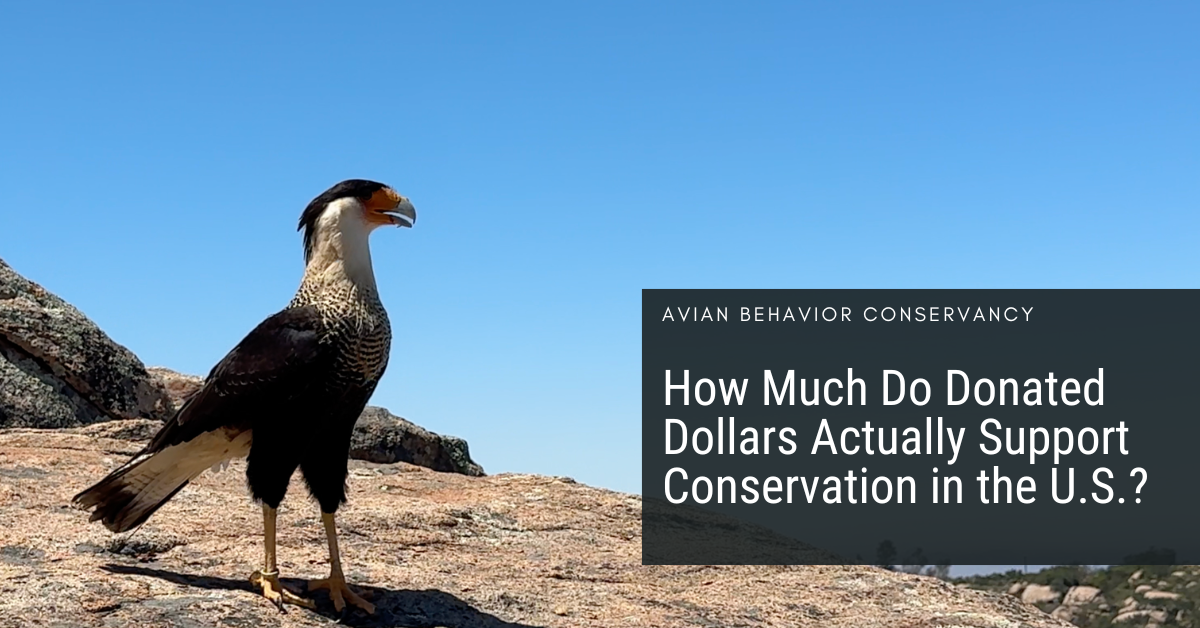
19 Mar How Much Do Donated Dollars Actually Support Conservation in the U.S.?
This year, we were able to do something that fundamentally changes the trajectory of our work.
In 2025, a single, transformative gift accelerated the Avian Behavior Conservancy’s research program by two full years—allowing us to establish a dedicated Conservation Biologist position far ahead of schedule. Today, we are proud to introduce Teresa Ely into that role.
This is what it looks like when funding directly fuels conservation work on the ground.
Meet Teresa Ely
Our connection to Teresa began in Spring 2025 at the Archives of Falconry Rendezvous, through a conversation with Dr. Julie Heath, Director of the Raptor Research Center at Boise State University.
That moment quickly evolved into something much larger. From that single conversation, we were able to witness the evolution of a shared vision for applied raptor research, long-term monitoring, and collaborative conservation work grounded in both field science and public engagement.
Teresa brings extensive experience in raptor ecology, telemetry, and field-based research design. Her work strengthens our ability to not only participate in conservation—but to lead it.
The Reality of Conservation Funding
In the United States, only a small fraction of total charitable giving is directed toward environmental causes, and an even smaller portion supports field-based conservation research. This is terrifying, given the state of decline our birds are in.
Most funding is highly competitive, inconsistent, and often vulnerable to broader shifts in federal priorities. In recent years, many field programs have experienced significant instability due to federal funding cuts, leaving critical long-term monitoring projects under-resourced.
This is the context in which this gift was made—and why its impact is so significant.
What This Gift Makes Possible
This funding does more than support existing work—it builds capacity for sustained, meaningful conservation impact.
With Teresa in this role, we are now able to:
- Develop and house our own research programs
- Expanding long-term monitoring and data collection initiatives
- Collaborate with leading conservation efforts
- Including partnerships with the Golden State Kestrel Research Network
- Supporting work in Butte Valley focused on Swainson’s Hawks
- Advance applied research alongside academic partners
- Integrating field data with broader conservation science efforts
- Bridge public engagement and field science
- Connecting the audiences who meet our ambassador birds directly to the conservation challenges those species face in the wild
This work creates a direct line between education, research, and conservation outcomes—ensuring that each strengthens the other.
Why This Matters Now
Field-based conservation work is increasingly dependent on flexible, mission-driven funding.
Programs that monitor species trends, track migration, and inform management decisions require continuity, expertise, and time. When funding disappears, so does the ability to maintain those datasets and respond effectively to population changes.
By investing in a dedicated Conservation Biologist, this gift supports more than a position, but the infrastructure needed to carry research forward in a meaningful, sustained way.
Looking Ahead
Teresa’s work will immediately accelerate several of our priority initiatives, including our expanding American kestrel research efforts and broader raptor monitoring collaborations across California.
As this role develops, it will continue to deepen the connection between the work our birds do in front of thousands of people each year and the conservation science happening behind the scenes.
A Direct Investment in Conservation
When people ask how much donated dollars actually support conservation work, the answer often depends on where those dollars go.
In this case, the answer is clear.
They are supporting:
- Field research
- Scientific collaboration
- Long-term monitoring
- And the people doing that work every day
We are proud to say that more donors have since looked at our conservation pillar and are eager to support and help shape this important work from the ground floor. How about you? Want to help us build this
They are building the foundation for conservation that lasts.