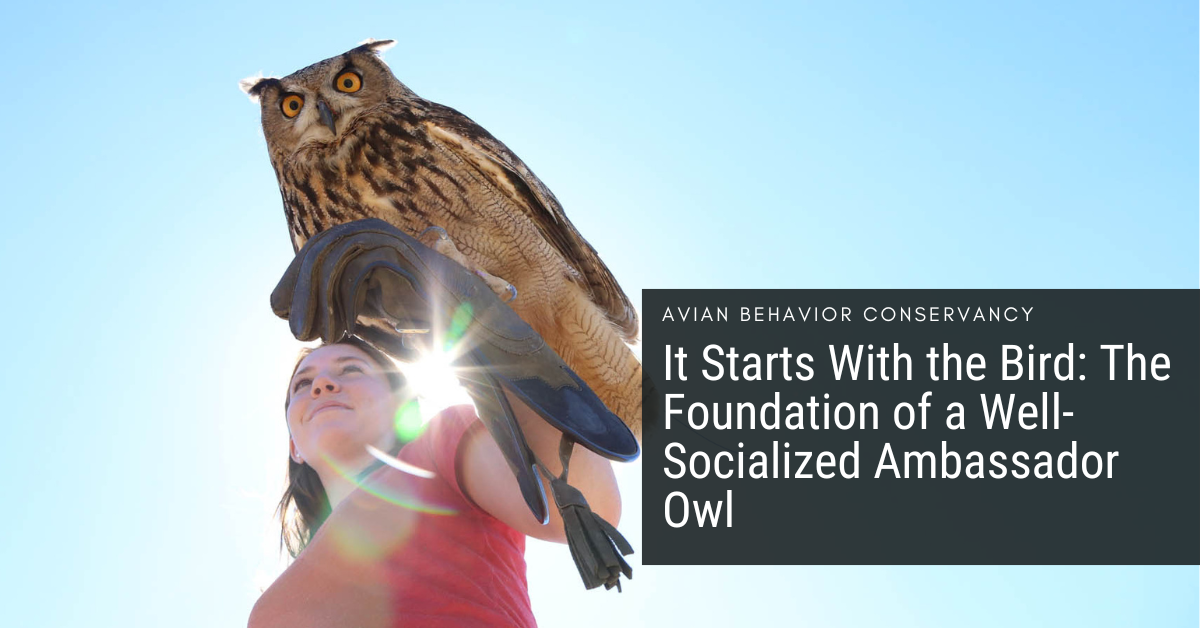
17 Apr It Starts With the Bird: The Foundation of a Well-Socialized Ambassador Owl
When we talk about raising a well-socialized ambassador owl, we are not starting with training plans or behaviors. We are starting with the bird. That choice shapes everything that follows.
Different species of owls come with different habits, preferences, needs, and motivation levels. The goal of building a positive learning history with an individual depends on understanding both where that bird comes from and what they have experienced. This is where ethology and experience meet. Anatomy plays a role, and so do the broader patterns of behavior that define a species. Habitat, foraging style, social dynamics, and courtship behaviors all inform how a bird interacts with its environment.
A grassland species like a burrowing owl carries a different set of safety values than a woodland species like a screech owl. That difference shows up early. It affects how a bird responds to novelty, how it seeks reinforcement, and how quickly it can build a stable set of skills.
By the time a bird enters a program, the species has usually already been chosen. It fits the education message or fills a role within the organization. That part makes sense. What follows is understanding what comes with that choice.
Small owls are often perceived as more approachable because of their size. What is less obvious is that free-ranging small owls experience higher extrinsic mortality than larger species. Predation, weather, food availability, and environmental pressures all contribute to this. In human care, that history can show up as a lower threshold for fear responses. Those responses are often subtle. They are easy to miss, and when they are missed, they accumulate. Cortisol levels rise with repeated exposure to stressors that go unresolved.
This is where staffing and experience level enter the conversation in a real way. The needs of the owl do not change based on what a team is ready for. If there is a mismatch, it will show up in the bird’s behavior, in the training process, and in the overall experience for both the team and the audience. Choosing a species is not only about messaging. It is about whether the environment and the people supporting that bird can meet what it actually requires.
From there, the focus shifts to the home environment. A sense of safety is not an abstract concept. It is something that is built through physical space, visibility, and predictability. What feels safe for one owl may not feel safe for another, even within the same species.
There is a tendency to model setups based on what has worked elsewhere. That can be useful, but it is not definitive. An aviary that is centrally located and exposes a bird to constant activity may work well for one individual. For another, it can lead to sensitization. Visual access to movement, people, and environmental change can increase vigilance rather than reduce it. In some cases, reducing visibility, adding structure, and creating more enclosed spaces leads to a calmer, more reliable bird.
Space itself is not always the solution. For small owls, larger enclosures can actually increase the perceived need to monitor for threats. Reducing the size of the space, limiting exposure through windows, and adding elements like burrows, foliage, or textured backdrops can change behavior without altering any other variable. The shift is often immediate because the bird’s sense of safety has changed.
These adjustments are not about making the environment simpler. They are about making it more appropriate. Some birds do not benefit from increased visibility, even when they appear to be watching their surroundings comfortably. Exposure to potential competitors, predators, or unpredictable activity can be enough to maintain a heightened state of alertness that never fully resolves.
Across all of this, the pattern is consistent. Behavior changes when the environment changes. Training becomes more effective when the bird is in a state where it can actually learn. A well-socialized ambassador owl is not the result of a single technique or a set of behaviors. It is the result of aligning species, individual, environment, and experience in a way that allows that bird to participate with confidence.
This is the work that sits underneath what the public sees.
Want to go deeper on building positive learning histories with ambassador birds? The Avian Behavior Lab covers the behavioral science behind every stage of this process, from species selection through program readiness.
Ready to put it into practice? Our Ambassador Owl Masterclass walks you through everything — from understanding your bird’s species-specific needs to building the environment and training foundation that sets them up for long-term success.
Enroll in the Ambassador Owl Masterclass
Or try the Lab free for two weeks using code AVIAN at avianbehaviorlab.com.