01 Jan What Creance Work Is Really Teaching You (and how to start asking better questions)
For many apprentice falconers and early-career professionals, creance work can feel deceptively simple.
The bird flies out. The bird comes back. The line stays untangled. Progress is measured in distance and reliability. We use the creance to give us an opportunity to layer recall with positive reinforcement to the glove, build fitness, and quickly get our birds ready for the field.
But where creance work in the beginning of your relationship with the bird is about mechanics to build trust, when you are looking to cut the bird loose from the line, this part is about judgment.
This post is for people who sense that doing the steps isn’t the same as understanding what’s happening. If you’ve ever watched a training session and thought, I wouldn’t know how to decide that, you’re in the right place.
What the Creance Is (and What It Isn’t)
A creance is a light line used in early raptor training so a bird can build flight skills without the risk of flying off. It allows learning to happen safely while the bird gains fitness and experience navigating space, distance, and return.
What it isn’t is a solution to uncertainty.
The creance doesn’t make a session thoughtful or safe on its own. It simply creates the conditions under which good decisions matter more. We always tell our students that you treat a bird on a creance the same way you would treat that bird fully free flighted: if you wouldn’t turn your back on it offline, don’t turn your back when they are on a creance.
Why This Session Is Worth Looking At
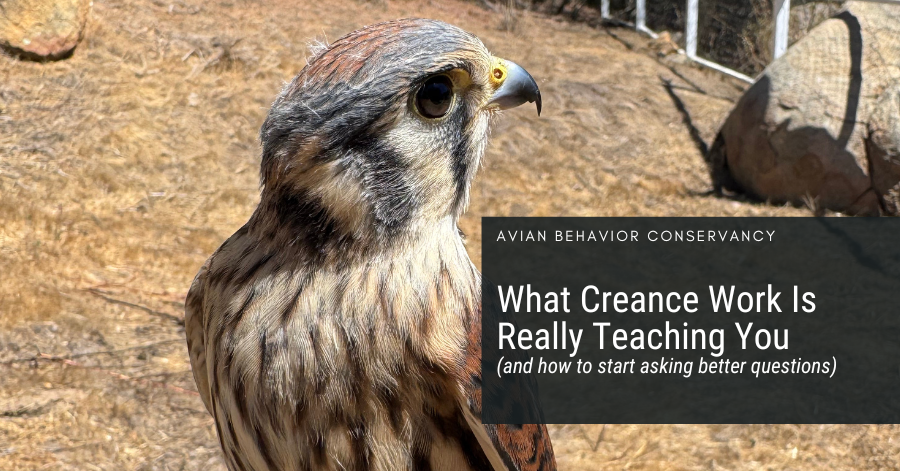
I posted a video with a voiceover talking through a session with our little American kestrel doing creance work. The video this post accompanies isn’t a step-by-step tutorial. It’s a narrow look at creance work under specific conditions:
- a first-year American kestrel
- strong, shifting wind
- a familiar training space
- working solo
- a bird nearing the end of creance training
Those constraints were an intentional set up on my part. They highlight the kinds of decisions that don’t show up in basic how-to guides, but strongly influence trust, clarity, and long-term handling.
Creance Work as Context Building
One of the quiet goals of creance work is helping the bird distinguish when flight is expected and when it is not.
This is why setup matters so much. I don’t fly my birds from a bow perch or block, as this can lead to bating if I have to tether them from that perch. A bird that is tethered should not be learning to anticipate flight simply because a human is approaching. Protecting that distinction early reduces confusion later and supports calm, predictable handling.
Clear context is not created by equipment—it’s created by consistency.
Voluntary Flight and Choice
In this session, the bird is not launched off the glove. Instead, flight begins when the bird initiates it. In fact, you’ll notice I hardly ever launch my birds from my glove.
When a bird chooses to leave, the handler gains insight into motivation, confidence, and readiness—especially under challenging conditions like wind. That information guides decisions about distance, reinforcement, and session length without forcing the bird through uncertainty.
Choice doesn’t mean absence of structure. It means structure that leaves room for the bird to participate meaningfully.
Training in Wind Changes the Conversation
Wind adds physical effort, unpredictability, and risk. It affects how a bird flies, how it lands, and how quickly fatigue or frustration can appear.
Working a kestrel on a creance in wind requires:
- conservative criteria
- shorter sessions
- careful line management
- constant environmental awareness
These conditions make it easier to see whether training choices are supporting the bird—or simply relying on the line to prevent mistakes.
Working Solo Raises the Bar
Training alone removes a safety net. Line handling, awareness, and movement must all be intentional.
This doesn’t mean solo creance work is unsafe—but it does mean it demands honesty. Familiar spaces allow flexibility, but only when paired with active observation and readiness to intervene.
The question becomes less Can I do this? and more What information do I need to keep this session clean?
The Throughline: Progressive, Choice-Based Training
Across all of these elements—species, weather, space, and setup—the same core concepts apply:
- clarity over speed
- information over force
- trust over compliance
Creance work is an important early step on the way to free flight. It’s where patterns are set, expectations are formed, and the bird learns how safe it is to make decisions around you. We don’t use creance work on all of our birds, but when we have it, we use it thoughtfully.
Learning to See the Decisions
This post isn’t meant to give you answers to copy. It’s meant to help you notice the decisions that are happening long before anything looks “wrong.” We
If you get to watch a session that makes you pause and ask:
- Why did that choice matter?
- What would I do if one variable changed?
- What information am I actually getting from the bird right now?
then the creance is already doing more than keeping the bird from flying off.
And so are you.
Want to see our courses on creance and other falconry and bird of prey training in the Avian Behavior Lab? Use coupon code AVIAN for a 14-day free trial and check out the video I am referring to in our falconry section!