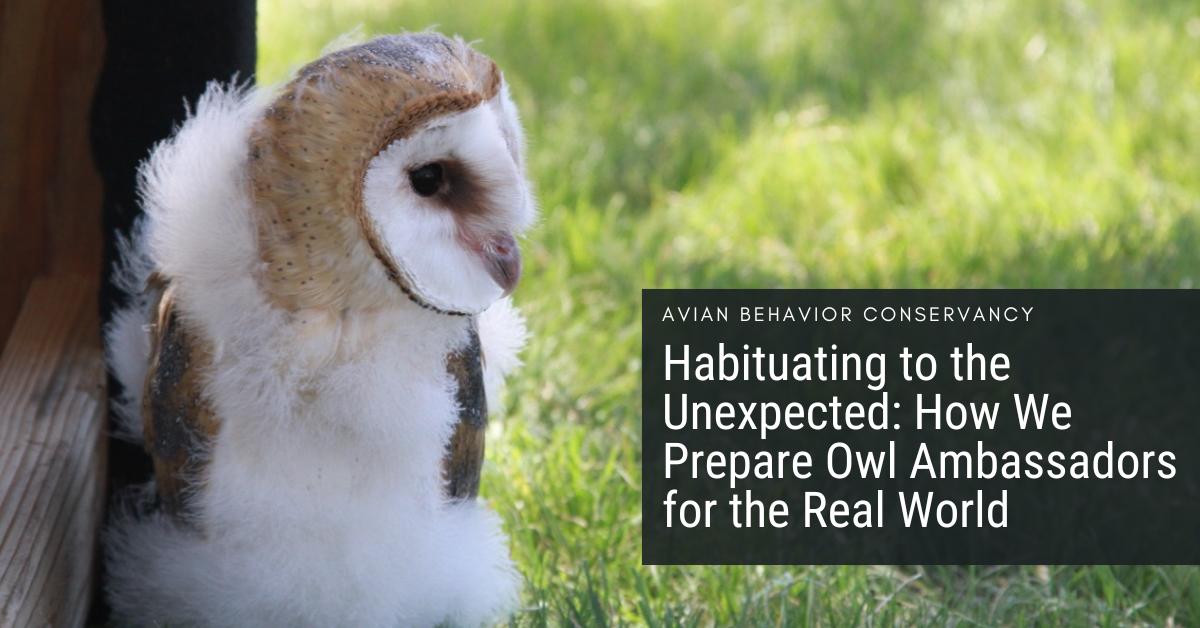
09 Feb Habituating to the Unexpected: How We Prepare Owl Ambassadors for the Real World
One of the core goals of ambassador training is deceptively simple: we want our owls to experience abnormal situations as normal parts of life.
Over the years, we’ve learned that resilience doesn’t come from avoiding challenges—or from overwhelming birds with them. It comes from thoughtful exposure, timing, and a training foundation that teaches owls how to cope, not just how to tolerate.
In this phase of our work, we focus on habituating owls to novel stimuli—movement, sounds, people, equipment, and environments they’ll encounter as ambassadors. The goal isn’t to make these things “no big deal.” The goal is to help the bird develop flexible, calm responses when the world gets weird.
Learning to Use the Right Tools (and the Right Words)
One thing we’re very open about now is that we didn’t always describe—or apply—these principles perfectly.
In the broader training world, terms like desensitization and counterconditioning get used constantly, even when other processes are actually at play. Part of our growth as trainers has been learning to identify which learning principle is truly operating, and then using it intentionally and ethically.
That clarity matters for two big reasons:
- The casual misuse of terminology has led to the unnecessary demonization of concepts like negative reinforcement, even when used non-coercively and thoughtfully.
- When you understand which principle you’re using, you understand how to apply it responsibly, and—just as importantly—when not to use it.
In this work, we combine habituation, shaping with positive reinforcement, and non-coercive negative reinforcement to build communication, confidence, and emotional regulation. None of these tools are inherently good or bad. What matters is how, when, and why they’re used.
Timing Is Everything—Especially Early On
When we introduce novelty pre-fledging, it’s not because the owl “can’t get away.”
In fact, relying on that alone is a fast track to sensitization—creating bigger problems down the road. Developmental stages matter. Certain windows support curiosity and learning; others amplify fear responses. We don’t rush the big stuff, but we don’t delay it so long that novelty becomes threatening.
As soon as the bird is physically and psychologically ready, we begin gently expanding their world.
That might mean:
- Outdoor walks or supervised playtime
- Riding in the back of a golf cart to experience motion
- Changing scenery multiple times a day
- Exposure to different sounds, light levels, and activity patterns
We watch body language closely. Curiosity, scanning, and engagement tell us we’re on the right track. A “shrinking violet” response tells us to slow down.
Normalizing a Busy World
At this stage, novelty isn’t an occasional exercise—it’s part of daily life.
There’s almost always something happening around the owl: raking, vehicles, voices, people, unfamiliar objects. On quieter days, we get creative—podcasts with unusual voices, odd hats, short drives down the driveway and back.
This isn’t about checking boxes or declaring a bird “trained” for a specific stimulus. It’s about constant reaffirmation that their life will be dynamic.
Just like an urban bird learns to navigate a complex soundscape, ambassador owls need to learn that their world isn’t limited to a mews and a few hours of predictable work each week. That expectation simply isn’t realistic—for them or for us.
When Things Don’t Go Smoothly (and They Won’t)
No matter how well you prepare, setbacks happen.
We’ve had sessions that felt awful in the moment—messy, overwhelming, and humbling. But when we revisited them later, especially on video, we often realized just how much learning actually occurred for everyone involved.
Sometimes trigger stacking pushes a bird over threshold, and suddenly your mind is racing as the owl suddenly starts offering behavior after behavior.
This is where preparation matters most.
If you’ve set up your session with proper support, safety, and escape options—and if your goal is learning rather than protecting your ego—you can rely on the training foundation you’ve built. The objective isn’t perfection. It’s extracting as much information and growth from the session as possible.
Teaching Calm as a Functional Skill
When working with larger or more intense stimuli, we often pair positive and negative reinforcement while watching body language closely.
By starting with predictable, lower-level challenges (like raking programs), the owl learns a powerful lesson: calm behavior changes the environment.
The stimulus slows, softens, or stops altogether. Over time, the aversive quality of that stimulus can shift—sometimes becoming neutral. What a stimulus “is” to a bird isn’t fixed; it’s shaped by learning history and consequences.
We’re not training owls to tolerate specific scary things. We’re building broad coping skills that generalize across situations.
Why We Don’t Rely on Manning
There are rare cases where manning plays a role—but never as a foundation, and never with imprinted owls.
Manning isn’t skill-building. In most cases, it teaches the opposite: that the bird’s behavior doesn’t meaningfully affect outcomes. When that’s the core of a training program, setbacks tend to collapse everything. The bird has no tools to fall back on.
In contrast, a bird raised with choice, movement, and functional skills can navigate challenges—even when things don’t go perfectly.
Reflect, Review, and Share
If you’ve ever walked away from a session thinking, What did we even gain from that?—you’re not alone.
Revisit the video a few days later. You might be surprised how much learning was happening beneath the surface.
And if you’re still unsure, share it. Our Avian Behavior Lab community has a knack for finding the lesson hiding inside the hard moments.
Because growth—for trainers and birds alike—rarely looks clean while it’s happening.
Take Your Owl Training Further
Want to dive deeper into habituation protocols, learning principles, and troubleshooting ambassador owl training?
Our Owl Ambassador Masterclass covers everything from early exposure strategies to ethical use of negative reinforcement, building functional coping skills, and moving beyond traditional manning approaches.