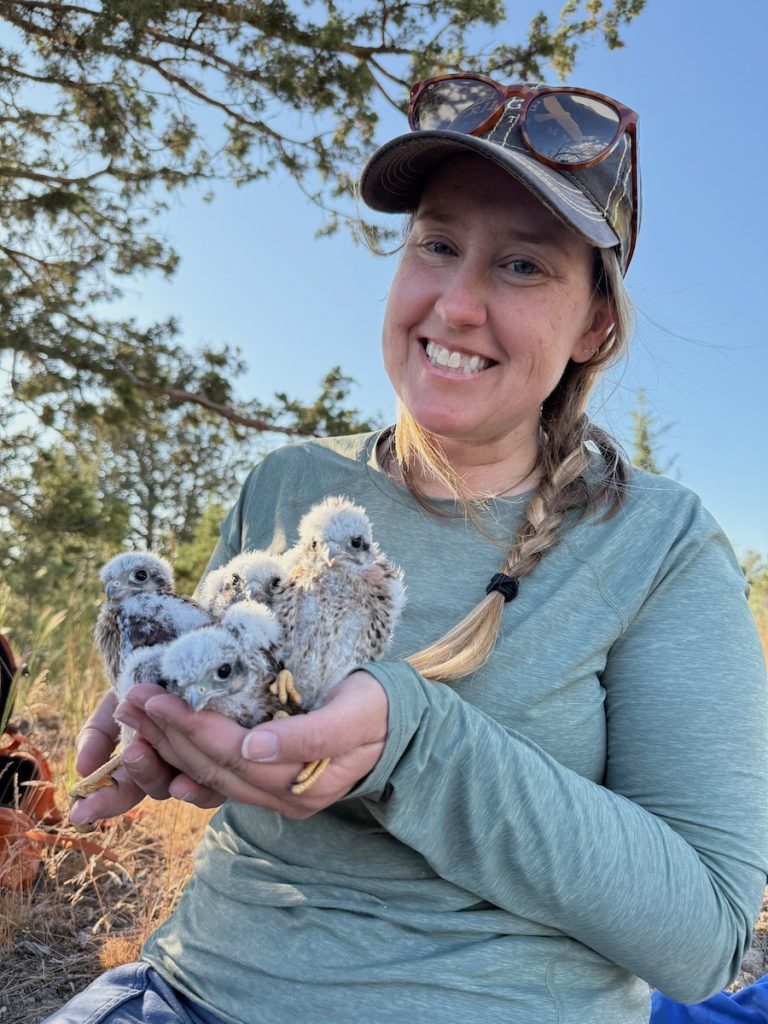
Teresa Ely is a raptor biologist with nearly three decades of experience studying birds of prey across western North America. Her research focuses on raptor ecology, migration, and movement patterns, integrating traditional field techniques such as capture and banding with modern wildlife tracking technologies.
Teresa began working with raptors in the 1990s at the San Francisco Zoo, where she volunteered in public education programs involving birds of prey. She has since worked at raptor migration monitoring stations across the western United States and Mexico.
She holds a Master’s degree in Evolution, Ecology, and Behavior, where her thesis analyzed American Kestrel banding and count data from multiple long-term migration stations across the United States. Her research examined patterns of body size change, population dynamics, and environmental stressors affecting kestrels.
Teresa previously served for nearly a decade as Banding Manager and Senior Biologist at the Golden Gate Raptor Observatory. Over the course of her career, she has captured, banded, and studied thousands of raptors, contributing to large collaborative datasets used to understand migration timing, population trends, and climate-driven changes in raptor movements.
Her current research integrates long-term banding datasets with emerging technologies, including the Motus Wildlife Tracking System and GPS telemetry, to better understand how raptors move across landscapes and how those movements connect breeding, migration, and wintering areas. In addition to her work on American Kestrels, she also conducts research on species including Swainson’s Hawks, Ferruginous Hawks, Red-shouldered Hawks, Golden Eagles, and Burrowing Owls across California.
She is the founder of the Golden State Kestrel Research Network, a collaborative initiative focused on studying American Kestrels across California. Through partnerships with researchers, conservation organizations, and community volunteers, the network works to expand research on kestrel ecology and inform conservation efforts for this declining species.